

High safety: When broken, glass pieces stay bonded to the interlayer, significantly reducing the risk of injury.
Impact resistance: Provides increased resistance against impacts, forced entry, and accidents.
Sound insulation: The interlayer helps reduce noise transmission, making it ideal for noisy environments.
UV protection: Blocks a large percentage of harmful ultraviolet (UV) rays, protecting interiors and furnishings.
Transparency and aesthetics: Maintains a clear, elegant appearance while offering superior safety.
Typical physical characteristics:
Density: ~2,500 kg/m³
Low thermal expansion
Good mechanical strength for further processing

Laminated glass is a type of safety glass made by bonding two or more glass sheets together with a special polymer interlayer (most commonly PVB – Polyvinyl Butyral, EVA, or SGP) under heat and pressure.
Even if the glass breaks, the fragments remain attached to the interlayer instead of scattering.
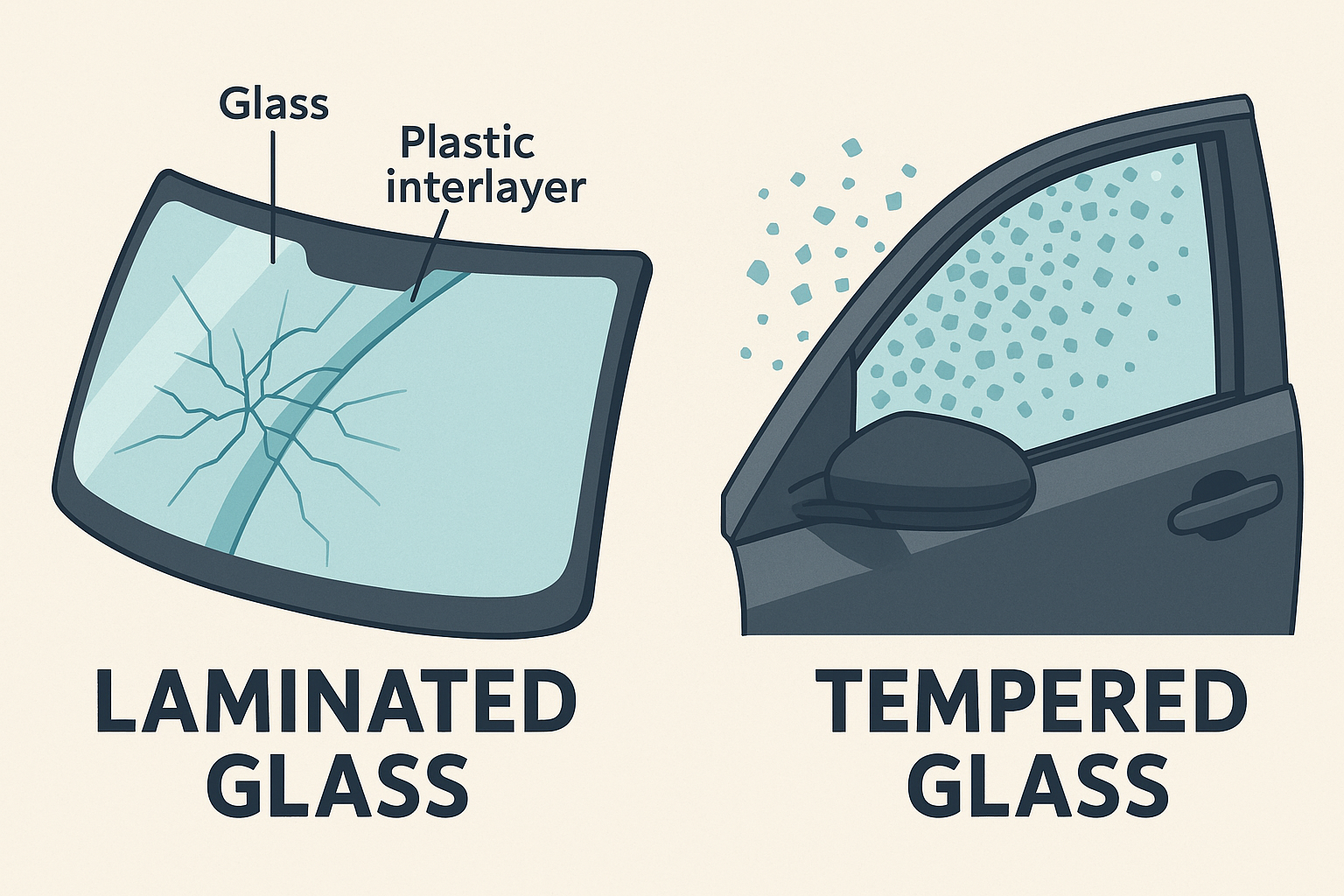
Laminated Glass vs. Tempered Glass
Tempered glass: Strengthened by heat treatment; when broken, it shatters into small blunt pieces.
Laminated glass: Holds together when broken due to the interlayer, offering higher post-breakage safety.
For areas requiring maximum protection, laminated glass is generally safer. In some applications, both technologies are combined as laminated tempered glass.

Safety Standards
Laminated glass can be manufactured to meet international safety standards depending on its intended use, such as:
EN 356: Resistance to impact and burglary
EN 1063: Bullet-resistant glass classifications
These standards define the level of protection the glass provides.